NewVersion 8 of the Upstream Works platform
Totalix™The advanced contact center that runs where you do.
Five editions. One omnichannel platform. Native AI. Cloud, dedicated, partner or on-premise. Your architecture, never a forced migration.
Deployable from 1 December 2026 · Explore Totalix → · Watch the product demos ↓
01Your sector
Built for the sector you work in.
Six sectors, each with its own avoidable contact and its own fit. Pick yours, or see all six.







- Travel & HospitalityWhen plans change, your team stays ahead.
- Financial Services & BankingHigh-stakes interactions handled with precision.
- HealthcarePatients reach the right person, the first time.
- GovernmentEvery citizen gets a clear, consistent answer.
- RetailHigh-quality CX regardless of season or staffing.
- Utilities & TelecomTurn outage anxiety into CX confidence.
02The platform
One platform that runs the conversation — and learns why it happened.
Totalix™ is Version 8 of the Upstream Works platform: a multi-tenant, CRM-embeddable agent workspace — human or AI — that goes live inside your business application in minutes in the cloud. Four products complete the family.
Totalix™
Five editions, one platform. Every buyer conversation starts with which edition fits how you already run — then you choose how to deploy it.
UWXP
Agentic reasoning and decision intelligence on specialized small language models, with no training on your data.
UW Knowledge & Assist
UW Knowledge & Assist (formerly UW Assist) is knowledge management and real-time agent assist for contact centers: one governed knowledge platform for agents, employees and customers, authored once and served everywhere.
Agents · employees · customersExplore UW Knowledge & Assist →Analytics & reportingUW Insights
Unified, real-time and historical reporting across channels, agents and AI — so you can prove the failure demand is falling.
Across the whole Totalix™ familyExplore UW Insights →Video & co-browseAgentNow
Video engagement and co-browsing for the issues that need to be seen, not described — fewer repeat calls and site visits.
Already in live customer useExplore AgentNow →03Your fit
Five editions. Your deployment.
Pick the edition that matches how you already run, then how you want to deploy it. Deployment is a choice you make on every edition — not a separate product.
Edition
Deployment
Not sure yet? Request a demo and we’ll show you the edition that matches how you run today — or join the waitlist and choose with your onboarding contact.
Totalix Complete Flagship
A full omnichannel contact center — voice, digital, agentic AI, advanced routing, queuing, agent management, real-time reporting and deep analytics — with no external platform dependencies.
Best for: organizations with no incumbent platform — and teams tired of expensive, inflexible monolithic CCaaS.
Request a demo — Totalix Complete04UWXP — the AI experience layer
Totalix™ runs the conversation. UWXP works out why it happened — and how to stop it recurring.
Routing is solved. Reasoning isn’t.
Between 40% and 60% of contact-center volume is typically failure demand, a concept developed by John Seddon and Vanguard Consulting: contact caused by a failure to do something — or do it right — the first time. It is the most expensive work a contact center does, because it creates no value at all. UWXP reasons over why it happens, inside Totalix™ or beside the platform you already run.
Customers can’t tell what applies to them, so they ask.
Self-service fails mid-task and the customer calls.
Context is lost between teams, so the story starts again.
How much of your volume shouldn’t exist?
Illustrative estimate from your own inputs: what avoidable contacts cost today, not a forecast of savings. The 40–60% range is credited to John Seddon and Vanguard Consulting. See the definition of failure demand.
Review this estimate with us05The path
No rip-and-replace. Move at the speed of your results.
Coexist
UWXP runs alongside your current contact-center platform, reasoning over real demand from day one.
Displace
Shift more journeys to UWXP-led resolution as the failure-demand numbers prove out — one queue at a time.
Replace
Replace legacy routing when the evidence says you’re ready — not before.
06UW TV
Watch it before you talk to us.
See Totalix at work in short product demos of the Complete, for Cisco, Embedded and Mobile editions, with captions and the full transcript. Then catch up on UW TV: one flagship video a month, tied to something real.
Product demos
Totalix Complete
The Totalix Complete agent desktop: real-time transcription, AI-suggested responses, Salesforce context, transfers, UW Knowledge & Assist summaries and sentiment, email, and AgentNow video.
Read the transcript of the Totalix Complete demoTotalix for Cisco
Totalix for Cisco with Webex Contact Center: Webex routing and notifications, AI-suggested responses with a choice of tone, picking up queued work, Webex Calling with WebRTC call controls, transfers, and AgentNow video.
Read the transcript of the Totalix for Cisco Webex Contact Center demoTotalix for Cisco in a single Cisco Finesse gadget on UCCE, PCCE and WCCE: Cisco routing through MR PG, AI-suggested responses with a choice of tone, AgentNow escalation from chat to video, UW Assist summaries and sentiment, and every channel in one workspace.
Read the transcript of the Totalix for Cisco Cisco Finesse demoTotalix Embedded
Totalix Embedded inside the CRM: a WebRTC softphone with screen pops, AI-suggested responses, automatic wrap-up notes and sentiment, SMS without leaving the CRM, transfers, and AgentNow video.
Read the transcript of the Totalix Embedded demoTotalix Mobile
Totalix Mobile on a phone: clear notifications, interaction history, AI-suggested responses, a WebRTC softphone, real-time transcription, and AgentNow video.
Read the transcript of the Totalix Mobile demo
Totalix for Amazon Connect arrives in January 2027.
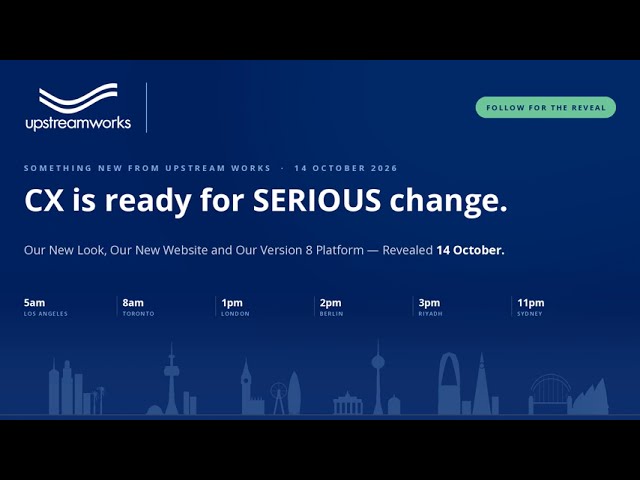
Latest on UW TV
07Proof



Recognized for innovation in CX.



Sold and delivered through 50+ partners worldwide, including Presidio, TTEC Digital, Natilik, Endava, World Wide Technology and Raise GTM. Find a partner →
08Trust Center
Security you can check for yourself.
Upstream Works is ISO 27001:2022, SOC 2 and HIPAA compliant. We validate our program through routine penetration testing and third-party audits, and our controls are monitored continuously — so your security review starts with evidence, not a questionnaire.
73 security controls across 5 areas, monitored continuously. See how we secure your data →
Explore the Upstream Works Trust Center
All 73 of our security controls by area, our compliance status and our latest security updates.
Explore the Trust Center →09Request a demo
See Totalix™ and UWXP on your use case.
Tell us who you are and what you run. We’ll show you Totalix™ and UWXP on your use case, in your CRM, deployed your way.
- A live tenant, not a slide deck
- The engineer who knows your platform
- Or connect with one of our 50+ partners
Want your own Totalix trial tenant from 1 December 2026? Join the waitlist →
Thanks — your demo request is in.
We’ll be in touch shortly to arrange your demo.
What happens next
- Your request goes straight to the Upstream Works sales lead for your region.
- We’ll contact you within one business day.
Request a demo
Our online form is having trouble right now. Please send your request by email and we’ll take it from there.
Send by email instead